The few-shot distraction effect —> when more examples degrade LLM constraint adherence
Our recent systematic evaluation of instruction-following models on IFEval reveals a counterintuitive finding: increasing the number of in-context examples can significantly degrade performance on constraint-following tasks.
The experiment:
Using the lighteval framework, we evaluated SmolLM2 variants and LFM2-350M across 0-shot through 5-shot configurations.
The results:
Across all three models, we observed significant degradation in both instruction-level strict accuracy and prompt-level strict accuracy as the number of shots increased.
Why does this happen?
IFEval tests a model's ability to follow specific, verifiable constraints:
- "Write exactly 4 paragraphs"
- "Mention the keyword 'AI' at least 3 times"
- "Format your response as JSON with keys 'title' and 'content'"
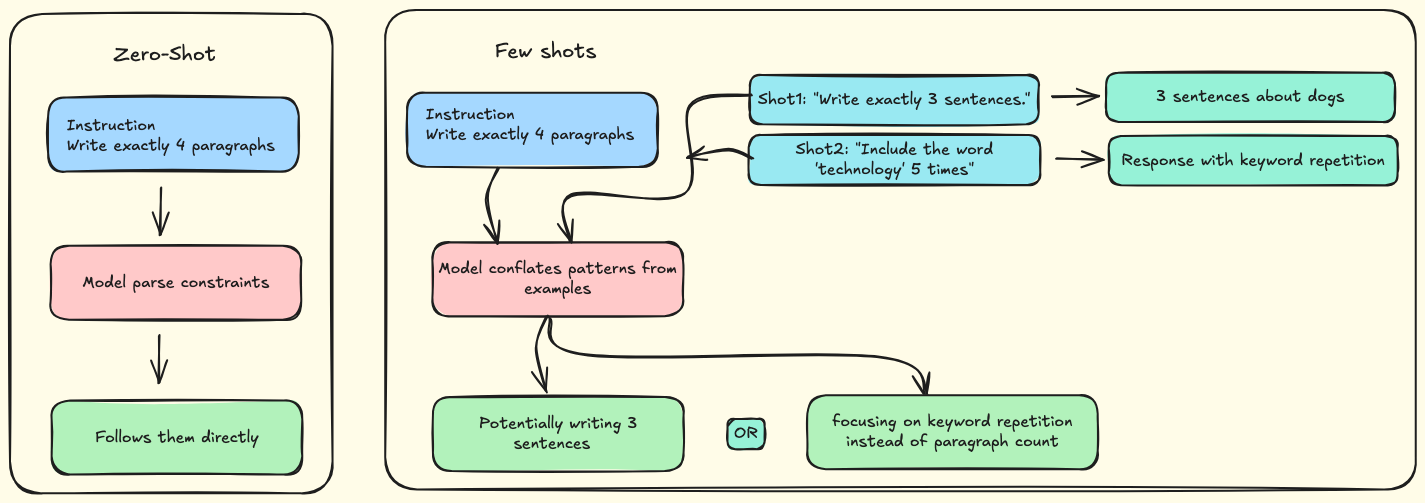
When few-shot examples are added, models get distracted by the content patterns in those examples rather than focusing on the specific instructions of the current task. This observation aligns with recent research (arXiv:2501.10860v2), where similar experiments found that models "get distracted by the content of few-shot examples."
Understanding the mechanism:
The model shifts from instruction parsing to pattern matching, causing it to miss or violate specific constraints in the target instruction.
Key insight:
The number of in-context examples must be carefully calibrated based on task objectives. While few-shot learning often improves performance on tasks requiring pattern recognition or domain knowledge transfer, it can degrade performance on tasks demanding strict constraint adherence. As noted in recent work on many-shot learning (arXiv:2501.04070v3), more shots don't universally improve outcomes.
Is this a prompting failure or a fundamental model alignment issue? How do you force your LLMs to prioritize instructions over example patterns? Questions to be addressed in a future blog.
Practical implications:
Before selecting your prompting strategy:
- Identify what your task truly measures: pattern matching or constraint adherence?
- Test systematically across different shot counts (0, 1, 3, 5, 10).
- Measure the specific metrics that matter for your use case.
- Choose the approach aligned with your evaluation goal.
For instruction-following benchmarks like IFEval that emphasize constraint compliance, zero-shot evaluation may actually be optimal.
References:
- IFEval Benchmark: arXiv:2311.07911v1
- HuggingFace Open LLM Leaderboard: https://huggingface.co/docs/leaderboards/open_llm_leaderboard/about
- Supporting research: arXiv:2501.10860v2, arXiv:2501.04070v3